
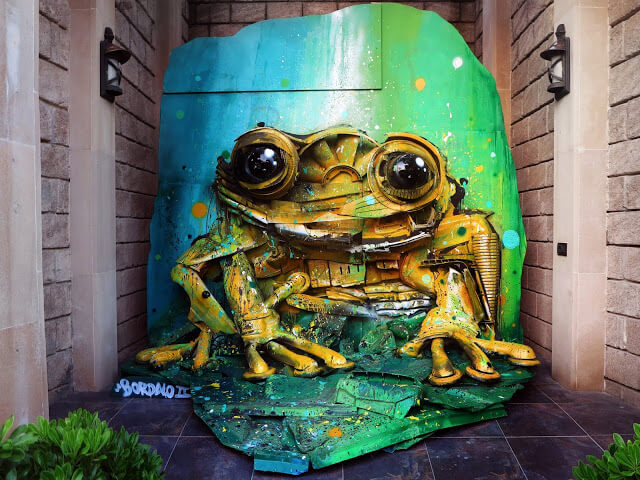
The Swan Valley is set to become home to a major new outdoor sculpture trail featuring large-scale wildlife works by internationally acclaimed Portuguese artist Artur Bordalo, better known as Bordalo II. The $2.2 million project, a Cook Government election commitment delivered in partnership with arts organisation FORM, aims to create a destination attraction that draws visitors deeper into the region’s wineries, cafés and heritage areas while highlighting local wildlife, culture and stories of Country.
Bordalo II is renowned worldwide for his “Big Trash Animals” series — monumental sculptures and murals assembled almost entirely from discarded materials such as plastics, car parts and industrial waste. The works transform junk into striking animal forms while drawing attention to overconsumption and environmental damage. He visited the Swan Valley earlier this year to assess potential sites and meet Tourism Minister Reece Whitby, local MPs, Traditional Owners and community representatives.
Supporters point to tourism and cultural benefits
Proponents argue the trail will put the Swan Valley on the international map in the same way the Giants of Mandurah boosted visitation in the Peel region. Government statements describe it as a key part of diversifying the local economy and creating a vibrant new attraction that encourages longer stays and more spending at family-run businesses.
Tourism Minister Reece Whitby has said the project will “celebrate Perth’s unique landscapes and wildlife, highlight the cultural stories of Country, and provide a vibrant new attraction that draws visitors from across Australia and beyond.” Creative Industries Minister Simone McGurk has highlighted the significance of bringing an artist whose works appear across the globe to the Swan Valley wine region.
FORM says the project remains in its early stages, with decisions on exact locations and the number of sculptures still open to input. The organisation has outlined opportunities for local involvement, including fabrication of frames and footings in Western Australia, employment during installation, skill-sharing workshops, and complementary commissions for local artists to create companion works using recycled materials. Recent co-design workshops have invited both artists and tourism operators to shape supporting activities.
FORM CEO Tabitha McMullan has defended the engagement process, stating that individual conversations were chosen “so we can listen properly, understand their perspectives, and ensure their feedback genuinely shapes the project.” The organisation reports more than 14 months of contact with stakeholders, including Aboriginal cultural groups, and notes that Bordalo II took part in a Welcome to Country and discussions about culturally significant animals during his visit.
Local artists raise concerns over consultation
Not everyone is convinced. Several established Swan Valley artists say the project was largely decided before meaningful local input was sought, effectively presenting a “fait accompli.”
Sculptor Antonio Battistessa, whose Herne Hill studio has produced recycled-material works for five decades and who was a founding member of the Swan Valley Tourist Alliance, told Echo Newspaper: “This was not a dialogue, this was a one-way announcement. FORM came to me with an olive branch after they’ve made all the decisions, after they’ve made a contract.” He argued that the valley already has internationally exhibited sculptors skilled in recycled media and that local voices should have been prioritised. “You don’t come to us once you’ve made the contract,” he said, calling instead for formal dialogue and collaborative masterclasses.
Ron Gomboc, who with his wife Terrie has long operated Gomboc Gallery Sculpture Park, wrote that it was “very disrespectful to local sculptors who are the fabric of local heritage and have been totally ignored, despite the fact they have been full-time sculptors, in some cases, for decades.”
Dale Tilbrook of Maalinup Aboriginal Gallery acknowledged that consultation occurred but described it as limited in its ability to influence core decisions: “Although the consultation was very nicely done, it was essentially after the fact… What I would like to see is much more local involvement.” She stressed the importance of placing Aboriginal cultural storytelling at the centre of the project’s identity, noting it as a unique point of difference for the region.
Still taking shape
As of mid-October 2026, no final sites or launch date have been publicly confirmed. FORM continues to run workshops seeking input from local artists and tourism businesses on how the trail can best support the existing creative community and visitor economy. The government maintains that local artists, businesses and fabricators will be engaged in the build, installation and associated programming.
The Swan Valley already hosts a rich arts scene, from the large outdoor works at Gomboc Gallery to Battistessa’s studio and Aboriginal galleries. Whether the Bordalo II trail ultimately strengthens or sits alongside that existing creative fabric will depend on how the remaining consultation and local opportunities are delivered.
Residents and businesses can follow updates through FORM and the City of Swan. The project is intended as both a tourism drawcard and an environmental statement — its success may rest on how fully local voices shape the final outcome.
